Monday, May 20

Games from the Kent and Sussex Congress

Following on yesterday's entry, we present a selection of games from the recently-concluded joint Kent and Sussex Congress.  To begin, Mr. Yates, winner of First-Class Open Tournament A, here registers a fine victory over Mr. Dewing, who finished equal second in that event.


Next, Mr. Watt takes the measure of current City of London Champion Mr. George A. Thomas, winner of First-Class Open Tournament B.  (If we have one small quibble with our English friends, it is that designating tourneys as A and B may lead some to believe that the latter is comprised of weaker players.  As noted in our previous entry, participants were divided between the two events so as to make them of comparable strength.)


Here Mr. Tregaskis surprises Mr. Hanson with a Knight sacrifice on the 19th move:


Finally, Mr. Compton Ellis produces a winning attack on the Black side of a Ruy Lopez.  As so often occurs in modern chess, the prettiest variations are to be found in the notes, which we encourage our readers not to overlook.



Sunday, May 19

Cool-headed defense at the Kent and Sussex Congress

The joint Kent and Sussex Congress, held during the past week at Hastings, has now concluded.  As promised in this space, we now provide two fine games from the First-Class Open tournaments, the principal events of the gathering.

We use the plural, as the unexpectedly large number of entrants required the creation of two round-robin sections, A and B, the first with 12 participants and the second with 11.  Every effort was made to ensure that the sections were of equal strength; in particular, the two players widely acknowledged as the strongest, Messrs. Yates and Thomas, were deliberately separated, being placed in sections A and B respectively.  And indeed, Mr. Yates won his section handily, scoring ten games off the reel before conceding a draw in the final round, for a winning margin of three full points; Mr. Thomas likewise topped his section, with 8 points from 10 games played, and finished one and one-half points ahead of his nearest competitor.  There being no provision for a play-off, Mr. Yates and Mr. Thomas can each lay claim to having won a first-class tournament at the Congress.

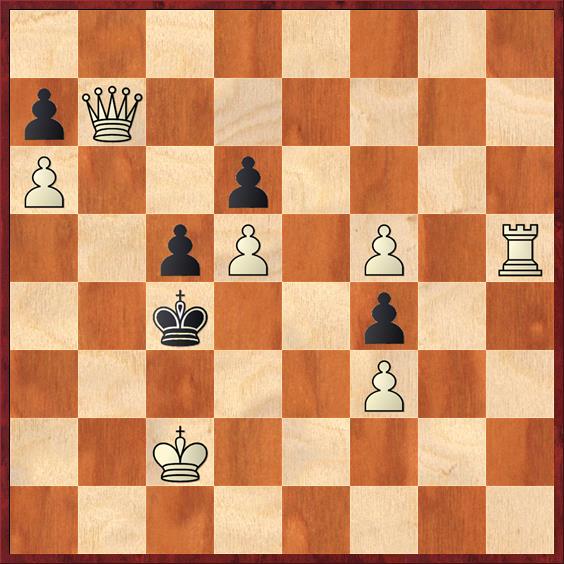
That the path of the two winners was not always an easy one may be observed from an examination of the games herewith subjoined.  In the first, Mr. Yates comes under a powerful sacrificial attack, only to turn the tables on his opponent through some clever tactics of his own.  Mr. Thomas similarly finds himself under heavy pressure, but survives to an endgame in which, not without help from his adversary, his extra piece prevails.  The concluding moves of this latter game, with only six units remaining on the board, once again bring us into the realm of Prof. Malinov, whose verdict is that Black at his 49th turn had one and only one move to draw, 49...Rd7.

We will offer more games from the joint Congress at Hastings in our next entry.


Saturday, May 18

King's Gambit Accepted: 3...d6!?

We present a game from a match over twelve boards held on the 4th inst. between two strong German sides, the Mannheim Chess Club and the Anderssen Chess Club of Frankfurt, won by the former by the narrowest of margins, 6 1/2- 5 1/2.  The contest below was played on first board between Herr Gudehus of Mannhein and Dr. Mannheimer of Frankfurt, who, through an irony of fate, lead the Frankfurt men into battle against representatives of the the city that gave him his surname.  The game itself, a pretty win for Herr Gudehus, warrants publication on its own merits; an added point of interest in its favor is the adoption by Dr. Mannheimer, as early as the third move, of a rare - indeed, practically unheard-of - defense to the King's Gambit, 3...d6.  We could not recall ever having seen this move played before, although a search through our card index did unearth a few examples of its adoption in practice, including some of considerable vintage: the consummate gambiteers Blackburne and Anderssen both faced it half a century ago, in 1862.

The move 3...d6 intrigues, and, upon reflection, one can only wonder at the rarity of its use.  If 3...g5, 3...d5, 3...Nf6, and 3...Be7 can all be played, then, one may ask, why not 3...d6 as well?  Dr. Mannheimer's lack of success with it in the current instance certainly cannot be considered a refutation.  Many more trials are required.  The King's Gambit is perhaps the most heavily-analyzed of all debuts, and the possibility of a new and virtually untested defense so early in the game, opening fresh paths and new vistas, would be most welcome indeed.  Perhaps all that is lacking for the move 3...d6 to gain currency is for some great player to become its champion, and to claim that it represents the best method of meeting White's attack.  Then, its popularity would soar.  But chess theory is often a slave to current fashion, and it may well be that another half-century will need to pass before this occurs.


Friday, May 17

San Francisco: A.J. Fink is new Mechanics' Institute Champion

From San Francisco now comes word that Adolf J. Fink, whom we recently introduced to our readers, has captured the Championship of the prestigious Mechanics' Institute Chess Club with the excellent score of 14 points from 15 games played.  Finishing a close second to the new Champion was veteran George Hallwegen with 13 1/2 points.  Mr. Hallwegen had the satisfaction of defeating young Mr. Fink in the final round to narrow the gap between the two experts to a mere half-point.  Third place fell to Bernardo Smith, an exceptional result when one considers that Mr. Smith only took up the game three years ago.  Mr. Smith, moreover, inflicted on Mr. Hallwegen the only defeat that the latter suffered during the course of the tourney, and will doubtless make his presence felt in future events.  We have heard that there is some talk of arranging a match between Messrs. Fink and Hallwegen; should such an eventuality come to pass, we shall of course report it in these pages.

We present three games from the tourney: a victory by Fink, the new Champion, over fourth-place finisher William Smith; the win by Hallwegen over Fink; and Bernardo Smith's defeat of Hallwegen. 


Thursday, May 16

Two Blackburne miniatures

At this writing the Kent and Sussex chess congresses are underway jointly in Hastings, and we expect to provide a selection of games therefrom in the very near future.  Among the many activities scheduled during this grand festival of chess was a series of simultaneous exhibitions by the veteran Master Joseph Henry Blackburne, a giant in the history of our game and a man who certainly requires no introduction to our readers.  Mr. Blackburne, despite having not long ago passed the proverbial age of three score and ten, still possesses a powerful combinative flair and an exceptionally keen sight of the board; in his first three exhibitions at Hastings the old campaigner scored a total 47 wins and 5 draws, without a single loss, all while tossing off a number of brilliancies en passant, as it were.

We present below two short victories by this Nestor of chess.  His opponents, Messrs. Grundy and Loye, while perhaps not of the first rank, are the current leaders of the Second-Class Open tournament at Hastings, and would, we suspect, test the mettle of many of our readers.  That they should succumb so quickly against Mr. Blackburne serves as a stark reminder of the vast difference in strength between a Master and a proficient amateur.  


Wednesday, May 15

Spielmann on tour

Rudolf Spielmann, following on his victory in the Vienna Chess Club Jubilee tournament, is currently on tour, having fulfilled engagements in Prague, Linz, and Trieste, among other locales.  We are pleased to present a fine game won yesterday by the traveling Master against the consulting team of Rozic and Jovanovic, played in Agram, a city perhaps also known to our readers as Zagreb.  The concluding checkmate, including a Queen sacrifice in true Spielmann style, is not to be missed.

Tuesday, May 14

Correspondence games, continued: Sacrifice and struggle

Our files contain such a large number of interesting games played by correspondence that we fear we shall never find time to present them all, especially as more continue to arrive with regularity, and other events in the chess world clamor for deserved editorial attention.  Still, today we take the opportunity to present two fine efforts from across the sea.  In the first, played in the recent British Chess Magazine correspondence tourney, Mr. Erskine enjoys the pleasure of announcing a pretty mate in 5 against Mr. Cole.  We invite our readers to ponder the position after Black's 21...Kxh7, given below, and to work out the mate for themselves, as an exercise.


Our second offering, played in a team tourney between squads from Lincolnshire and Norfolk, is a full-blooded, uncompromising struggle, a not uncommon occurrence in such events: the knowledge that one's own result will affect the fate of others often inspires a player to give his all.  We congratulate both participants on a fight well fought.  Notes, as in the previous game, based on those by Mr. Blackburne.


>

Monday, May 13

West Coast chess: San Francisco

On our return, as it were, from far-off New Zealand, we make landfall in San Francisco, where the Championship tourney of the Mechanics' Institute Chess Club is underway.  This club, one of the oldest in the United States, has in the past hosted visiting Masters of the caliber of Zuckertort, Pillsbury, and Maroczy, and boasts an active and accomplished membership.  We are particularly happy to note that the club has again found a permanent home, at 57 Post Street, after several years' residence in makeshift or temporary headquarters following the terrible earthquake and fire of 1906.

The subject of today's post is 22-year old Adolf J. Fink, a player of rare promise who bids fair to capture this year's Championship. Mr. Fink is also already developing quite a reputation as a problemist, unusual in one so young.  We present below two of his direct mate compositions, along with a game from the current Mechanics' Institute Championship tourney, for all of which we thank our friends at The San Francisco Call.  Solutions to the problems will be found at the close of this entry.

White mates in 3 moves


White mates in 3 moves


Solutions to the problems:

1.Qb2 Kxd5 2.Kc3 and mate in various ways on the following move according to Black's reply, the prettiest, in our opinion, being 2...Ke5 3.Kc4.

1.Ng5 Kxe5 (1...Kc6 2.Qb7+; 1...Kd4 2.Nce4) 2.Nd7+ Kd4 3.Qd2 mate.


Sunday, May 12

New Zealand Championship: Rollicking chess

We conclude our series of reports on the New Zealand Championship with a further selection of games from the event.  Our Antipodean friends are capable of producing some rollicking chess, as is evidenced, for example, by the following battle royal.  The winner, Mr. Kelling, finished in 6th place, with a score of 5 1/2 from 11 games; the loser, Mr. Dodds, finished 8th, with 4 1/2.


Mr. Dodds appears to be a particularly feisty player, though perhaps lacking a bit in steadiness and technique.  Witness the following clash, in which, unfortunately, one poor move near the finish undoes much earlier good work.


Having presented two of the gentleman's losses, it seems only just to offer a victory by Mr. Dodds.  Here he sacrifices a Knight early in the game and reaps the rewards nearly twenty moves thereafter:


A fighting spirit characterized the tournament, with players often displaying bulldog tenacity in difficult positions.  Here, in a clash between two of the three top finishers, Mr. Grierson, the eventual Champion, wins the exchange against Mr. Hicks, only to fall victim to his opponent's clever and unyielding resistance:


Finally, a striking reminder that the driest of positions can suddenly burst into flames.  We urge our readers not to overlook this encounter, in which a Rook endgame dry as driftwood leads to a heated race between passed pawns.  There is, in addition, a mystery at the close - see the note after Black's 45th move.


Saturday, May 11

New Zealand Championship: Play-off games

As we reported in an earlier entry, the tourney for the Championship of New Zealand finished in a three-way deadlock, with Messrs. Grierson, Gyles, and Hicks each having scored 8 1/2 points from 11 games.  Honors were likewise even in the games played between the members of this trio during the main tournament, as Grierson defeated Gyles, Gyles bested Hicks, and Hicks topped Grierson.  A play-off was therefore arranged to decide the Championship, with Grierson emerging as the clear victor after defeating Gyles and Hicks in succession, and so rendering a game between the latter two unnecessary.  The first play-off game, between Grierson and Gyles, was unfortunately marked by a terrible oversight on the part of the loser, who allowed mate in one in a position in which he certainly stood no worse; those who have experienced the physical and mental fatigue attendant to a long spell of tournament chess will well understand how such a thing could occur.  The game between Hicks and Grierson was a much more tightly-contested affair, which the new Champion decided in his favor only deep in the endgame - an endgame, moreover, that falls within the sphere of interest of our friend Prof. Malinov, as we shall discuss below.

First, the Grierson-Gyles game.


Before we turn to the game between Hicks and Grierson, allow us a short digression.  Once before, in our notes to the encounter between Duras and Flamberg from the Warsaw triangular tourney, we mentioned our clubmate Prof. Malinov and his life-long effort to analyze and tabulate simple chess endgames with a view toward determining the proper evaluation of all such positions, and demonstrating therein the shortest route to victory, or the surest path to a draw.  The good professor, who has gradually broadened the scope of his investigations over time, now believes that he has "solved" chess for all positions with six or fewer men remaining on the board, such a count to include the two Kings.  The task has been enormous.  We have personally seen Prof. Malinov's collection of handwritten analytical notebooks - they completely fill three large rooms in his home -  and we would have thought one lifetime insufficient to carry out such a task.  Be that as it may, the Hicks-Grierson endgame falls within the professor's purview after White's 56th move, and in the notes below we have related his observations on it.  As before, we are unqualified to pass judgment on the accuracy of Prof. Malinov's conclusions, and can only marvel at the labor it required to reach them. To the game:


We had thought to make this our final entry on the New Zealand Championship, but an examination of the remaining games from the tourney has revealed much worthwhile material, which we shall therefore present tomorrow.